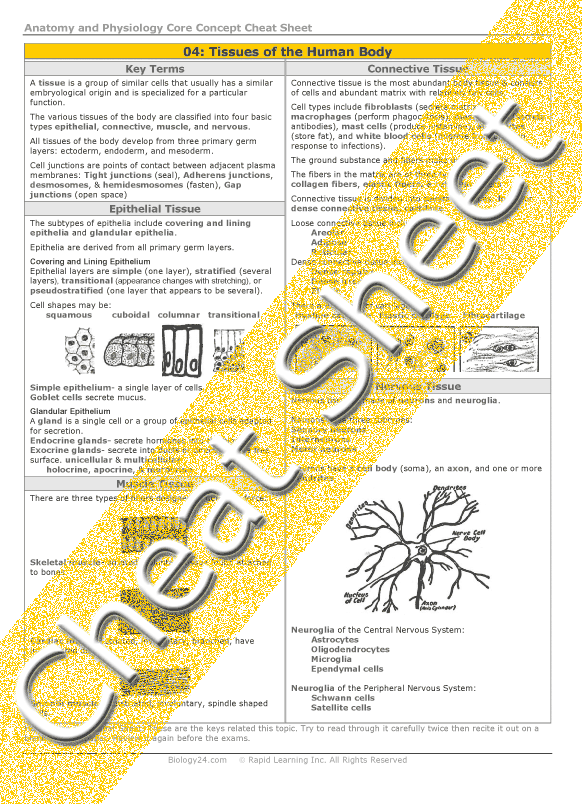
Tissue in the human body:
-
Epithelial: Is made of cells arranged in a continuous sheet with one or more layers, has apical & basal surfaces.
-
A basement membrane is the attachment between the basal surface of the cell & the underlying connective tissue.
- Two types of epithelial tissues: (1) Covering & lining epithelia and (2) Glandular Epithelium.
- The number of cell layers & the shape of the cells in the top layer can classify epithelium.
- Simple Epithelium - one cell layer
- Stratified epithelium - two or more cell layers
- Pseudostratified Columnar Epithelium - When cells of an epithelial tissue are all anchored to the basement Membrane but not all cells reach the apical surface.
- Glandular Epithelium – (1) Endocrine: Release hormones directly into the blood stream and (2) Exocrine - Secrete into ducts.
- Connective: contains many different cell types including: fibroblasts, macrophages, mast cells, and adipocytes.
Connective Tissue Matrix is made of two materials: ground substance - proteins and polysaccharides, fiber – reticular, collagen and elastic.
Classification of Connective Tissue:
- Loose Connective - fibers & many cell types in gelatinous matrix, found in skin, & surrounding blood vessels, nerves, and organs.
- Dense Connective - Bundles of parallel collagen fibers& fibroblasts, found in tendons& ligaments.
- Cartilage - Cartilage is made of collagen & elastin fibers embedded in a matrix glycoprotein & cells called chondrocytes, which was found in small spaces.
- Cartilage has three subtypes:
- Hyaline cartilage – Weakest, most abundant type, Found at end of long bones, & structures like the ear and nose,
- Elastic cartilage- maintains shape, branching elastic fibers distinguish it from hyaline and
- Fibrous Cartilage - Strongest type, has dense collagen & little matrix, found in pelvis, skull & vertebral discs.
- Muscle: is divided into 3 categories, skeletal, cardiac and smooth.
- Skeletal Muscle – voluntary, striated, striations perpendicular to the muscle fibers and it is mainly found attached to bones.
- Cardiac Muscle – involuntary, striated, branched and has intercalated discs
- Smooth Muscle – involuntary, nonstriated, spindle shaped and is found in blood vessels & the GI tract.
- Nervous: Consists of only two cell types in the central nervous system (CNS) & peripheral nervous system (PNS):
-
Neurons - Cells that convert stimuli into electrical impulses to the brain, and Neuroglia – supportive cells.
- Neurons – are made up of cell body, axon and dendrites. There are 3 types of neurons:
- Motor Neuron – carry impulses from CNS to muscles and glands,
- Interneuron - interpret input from sensory neurons and end responses to motor neurons
- Sensory Neuron – receive information from environment and transmit to CNS.
- Neuroglia – is made up of astrocytes, oligodendrocytes, ependymal cells and microglia in the CNS, and schwann cells and satellite cells in the PNS.
Development: All tissues of the body develop from the three primary germ cell layers that form the embryo:
-
Mesoderm – develops into epithelial tissue, connective tissue and muscle tissue.
- Ectoderm - develops into nervous tissue and epithelial tissue.
- Endoderm – develops into epithelial tissue.
Cell Junctions:
-
Tight Junctions - Form a seal between cells, define apical and basal sides of an epithelial cell
- Gap Junctions - An open junction between two cells, which allows ions, & small molecules to pass freely between the cells.
- Adherens Junctions - Link actin cytoskeletal elements in two cells.
- Desmosomes - Link keratin filaments in adjoining cells and resist shearing forces.
- Hemidesmosomes - Anchor keratin fibers in epithelial cells to the basement membrane through integrin anchors.
|