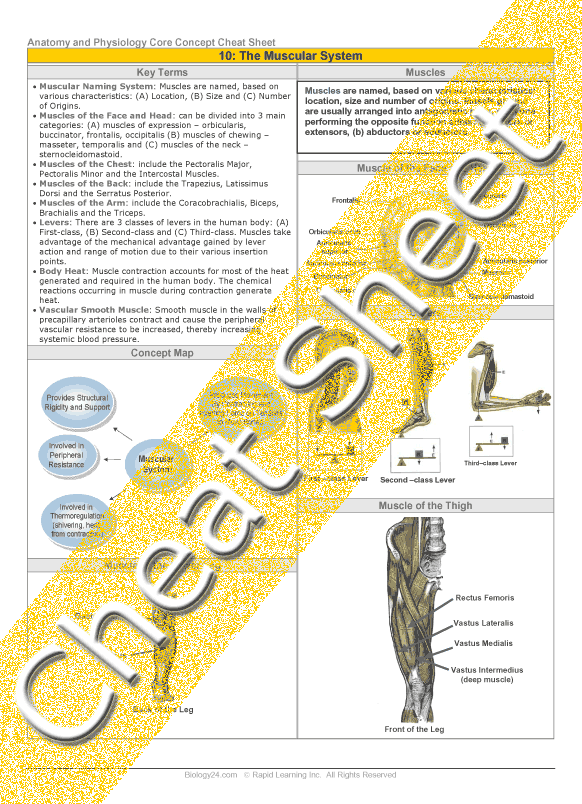
Muscle Naming System: Muscles are named, based on various characteristics.
- Location: muscles are named based on location, such as the tibialis anterior muscle, which is located near the front of the tibia bone.
- Size: muscles are named based on their size; maximus means larger and minimus means smaller. Examples include the pectoralis major and minor muscles of the chest.
- Number of insertions: muscles are named based on the number of origins, such as the quadriceps femoris, which has 4.
Muscle lever action: Skeletal muscles produce movement by contracting and exerting force on tendons, which in turn pull on bones. When producing a body movement, the bones act as levers and the joints act as fulcrums.
- First-class: the fulcrum is between the effort and resistance. There are only a few examples of this type in the human body.
- Second-class: the resistance is between the fulcrum and the effort.
- Third-class: the effort is between the fulcrum and the resistance.
Muscle Fascicles: Muscle fibers are arranged into bundles called fascicles. The pattern of fascicles effects muscle strength and motion.
- Parallel: In this arrangement, the fascicles are parallel with the longitudinal axis of the muscle, such as the stylohyoid muscle of the neck.
- Circular: In this arrangement, the fascicles are arranged in a circular pattern and enclose an orifice.
- Convergent: In this arrangement, the fascicles have a broad origin and converge to a narrow insertion.
- Pennate: In this arrangement, the fascicles are short in relation to the entire length of the muscle, and the tendons extend almost the entire length of the muscle.
Role of Muscles in Blood Pressure and Thermoregulation: Smooth muscle in the walls of precapillary arterioles contract and cause the peripheral vascular resistance to be increased, thereby increasing systemic blood pressure.
Muscles of the Human Body
- Muscles of the head and neck: The muscles of the face and head can be divided into 3 main categories: (A) muscles of expression – orbicularis, buccinator, frontalis, occipitalis (B) muscles of chewing – masseter, temporalis and (C) muscles of the neck – sternocleidomastoid.
- Muscles of the Neck and Shoulder: Sternocleidomastoid, Trapezius, Deltoid, Rotator Cuff: is a group of 4 muscles which hold the head of the arm bone in the shoulder joint and attach the arm to the chest.
- Muscles of the Chest and Back: muscle of the chest includes - Pectoralis Major, Pectoralis Minor and Intercostal Muscles. The muscles of the back include – Trapezius, Latissimus Dorsi and Serratus Posterior.
- Muscles of the Upper Extremity: the muscles of the upper arm include – Coracobrachialis, Biceps, Brachialis and the Triceps muscle. The muscles of the forearm include - Pronator Teres, Extensor Digitorum Communis and the Flexor Carpi Radialis. Muscles of the hand include - Palmaris Brevis, Abductor Digiti Quinti, Abductor Pollicis Brevis and the Flexor Pollicis Brevis muscle.
- Muscles of the Lower Extremity: the muscles of the thigh and shin region include - Quadriceps Muscles, Hamstring Muscles, Tibialis Anterior, Calf Muscles and yhe Extensor Digitorum Longus muscle. The muscles of the foot include - Plantar Aponeurosis, Abductor Hallucis, Flexor Digitorum Brevis and the Abductor Digiti Quinti.
|