Amino acids, Peptides and Proteins
| Topic Review on "Title": |
Structure, classification and nomenclature of amino acids
Amino acid refers to any compound containing an amino group and a carboxyl group. Amino acids are the basic structural units of proteins. They contain an amino group and a carboxyl group. Chiral carbon has four different types of atoms or groups attached to it. Most proteins are formed of 20 amino acids. Glycine is the simplest amino acid. Usually, amino acids are coded with three letters. Ex: Alanine is coded as Ala. Amino acids are classified into three categories: Aliphatic, aromatic and heterocyclic. Aliphatic amino acids are further classified into monoamino-monocarboxylic, monoamino-dicarboxylic, diamino-monocarboxylic, sulphur containing carboxylic acids. In neutral solution, amino acids are zwitterionic, with a positive charge on the nitrogen atom and a negative on the carboxyl group. All amino acids have the same general structure except proline.
Formation and classification of peptides
Peptide bond is formed by dehydration. Two amino acid molecules can be covalently joined through a peptide bond to yield a dipeptide. Peptide chain can be formed by the process of peptide bond formation between joining amino acids. When there are a few amino acids in a chain, usually 10-20, its called an oligopeptide. When there are more than 20, it is called a polypeptide.
Structure and function of proteins
Proteins are among the fundamental molecules of biology and are responsible for most of the complex functions that make life possible. The amino acid sequence of a protein determines its 3D structure. There are 4 classes of structure: Primary, secondary, tertiary and quaternary. Primary structure of proteins refers to linear number and order of the amino acids present. The ordered array of amino acids in a protein confers regular conformational forms upon that protein. These conformations constitute the secondary structures of proteins. β- Sheets are either parallel or anti parallel. α- helices and β sheet regions are connected by loop regions. Tertiary structure describes the relationship of different domains to one another within a protein. Quaternary structure describes about proteins containing several distinct polypeptide chains along with the non protein groups.
|
| Rapid Study Kit for "Title": |
| Flash Movie |
Flash Game |
Flash Card |
| Core Concept Tutorial |
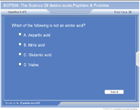
Problem Solving Drill |
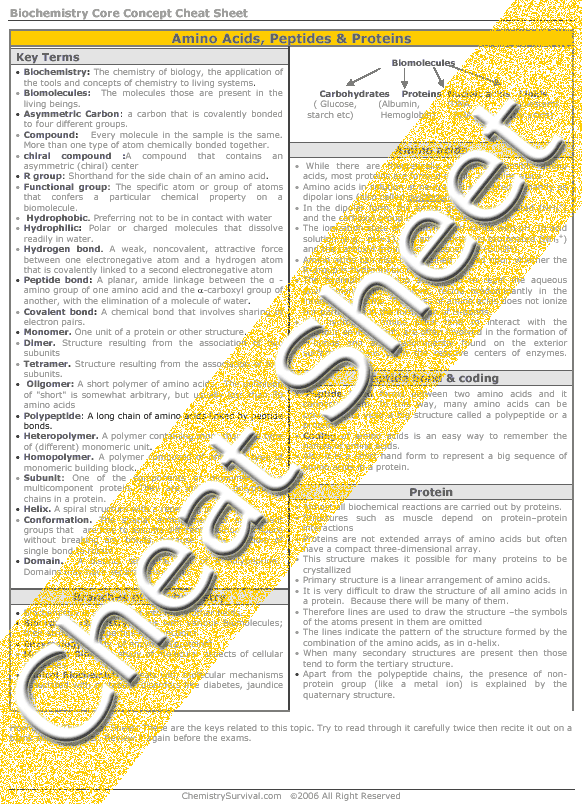
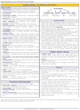
Review Cheat Sheet |
 |
 |
 |
|
| "Title" Tutorial Summary : |
Amino acids are the basic structural units of proteins. They contain an amino group and a carboxyl group. Chiral carbon has four different types of atoms or groups attached to it. Most proteins are formed of 20 amino acids. Glycine is the simplest amino acid. Usually, amino acids are coded with three letters. Ex: Alanine is coded as Ala. Peptide bond is formed by dehydration. Amino acids are linked with each other by peptide bonds. Proteins are among the fundamental molecules of biology and are responsible for most of the complex functions that make life possible. The amino acid sequence of a protein determines its 3D structure. There are 4 classes of structure: Primary, secondary, tertiary and quaternary.
|
| Tutorial Features: |
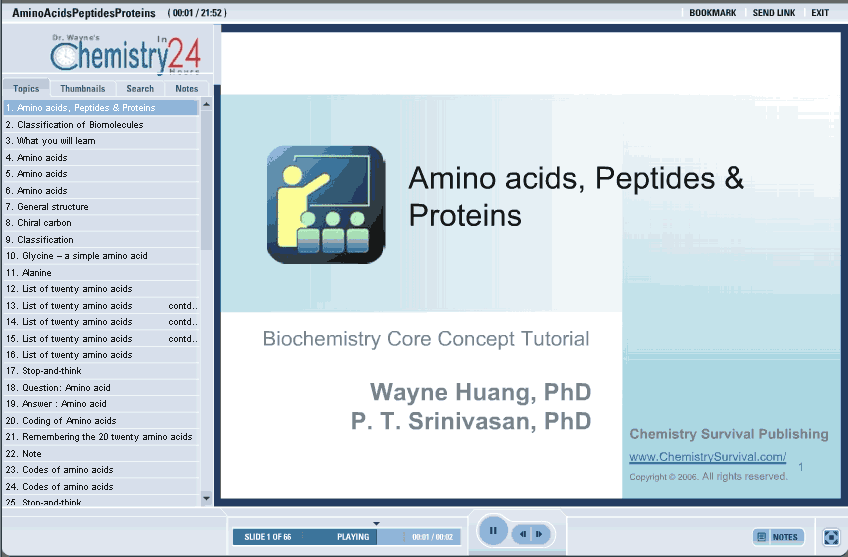
- General structure of an amino acid and chiral carbon is discussed with animation.
- Twenty amino acids are listed along with their structures.
- Codes of the twenty acids are listed as 3-letter and 1-letter code.
- Amino acid classification concept map is given.
- Primary, secondary, tertiary and quaternary pictures are discussed with diagrams.
|
| "Title" Topic List: |
Structure, classification and nomenclature of amino acids
- Introduction
- General structure
- Chiral carbon
- Classification
- Glycine and alanine
- List of 20 amino acids
- Coding of amino acids
Formation and classification of peptides
- Formation of a peptide
- Dipeptide
- Formation of a peptide chain
- Peptide linkages
- Classification
Structure and function of proteins
- Definition
- Structure
- Primary structure
- Secondary structure β sheet
- Connecting loops
- Random coil
- Tertiary structure
- Quaternary structure
|
See all 24 lessons in college chemistry, including concept tutorials, problem drills and cheat sheets:
Teach Yourself Biochemistry Visually in 24 Hours |