(877) Rapid-10
Rapid Learning in 24 Hours
  Home Site Map Contact Us
Rapid Learning Member Login  
BBBOnline Seal
 How to Learn in 24 Hours?

 Need Help?
M-F: 9am-5pm(PST):
Toll-Free: (877) RAPID-10
US Direct: (714) 692-2900
Int'l: 001-714-692-2900


24/7 Technical Support:
The Rapid Support Center

Online Order with Instant Access:
Buy Now with Instant Access
 Got Questions?
Frequently Asked Questions
 Need Proof?
Reviews and Testimonials


 Quick Search:
Keywords: 
 

 Member Login:
User ID: 
Password: 
 

 Rapid Learning Catalog:

AP in 24 Hours

MCAT in 24 Hours (Medical)

DAT in 24 Hours (Dental)

OAT in 24 Hours (Optometry)

PCAT in 24 Hours (Pharmacy)

Nursing Entrance Exams

Chemistry in 24 Hours

Biology in 24 Hours

Physics in 24 Hours

Mathematics in 24 Hours

eBook - Survival Kits

Audiobooks (MP3)


 Tell-A-Friend:
Have friends taking science and math courses too? Tell them about our rapid learning system.

 Gift Certificate:

Send a gift of education to someone you care. Give the learning edge with our rapid learning courses.

Product Code
  • RL-700-GP Premium
  • RL-700-GS Standard
  • RL-700-GL Lite

FAIL (the browser should render some flash content, not this).

Counting Molecules: The Mole

Topic Review on "Title":

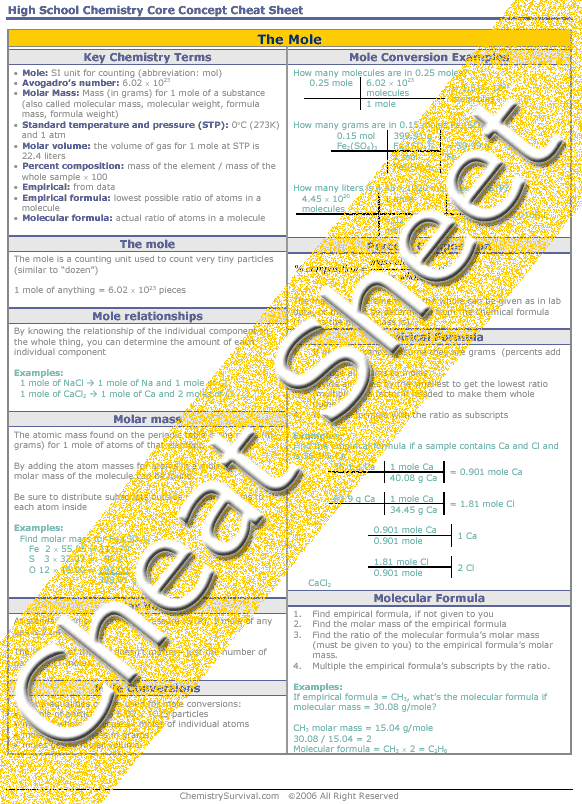
Atoms and molecules are so tiny that they need to be counted in very large quantities in order to result in a “workable” number. 

The mole
The mole (abbreviation: mol) is used to count particles.  1 mole of anything is 6.02 ´ 1023 of that thing. 

Molar mass
We cannot count out a mole of particles in the lab, therefore a connection between moles and mass is needed.  The molar mass is the mass (in grams) for 1 mole of the particle.  Molar mass (also often called Molecular mass, formula weight, etc.) is found by adding the atomic masses (multiplied by the number of that atom) for each atom in the molecule.  Molar mass can then be used in dimensional analysis conversions as the equality between grams and moles.  The molar mass value always goes with the “grams” in such conversions.

Percent Composition
“Percent” is part / whole ´ 100.  The “part” is the mass of an individual element while the “whole” is the mass of the whole molecule or sample.  These calculations can be done with lab data—grams of both the individual element and the whole sample—or with chemical formulas.  In the case of chemical formulas, the molar mass is used in the calculations.

Empirical Formula
The empirical formula is the lowest possible ratio of atoms in a molecule.  The ratio of atoms is the same as the ratio of moles of atoms.  The mass of each element is converted to moles and then all the moles are divided by the smallest to reach the lowest possible whole number ratio.  That ratio is used as the subscripts in writing the empirical formula.

Molecular Formula
The molecular formula is the actual ratio of atoms in a molecule.  The molar mass of the empirical formula is compared to the given molar mass of the molecular formula.  The comparison results in a factor that is used to multiply the subscripts of the empirical formula to reach the subscripts of the molecular formula.



Rapid Study Kit for "Title":
Flash Movie Flash Game Flash Card
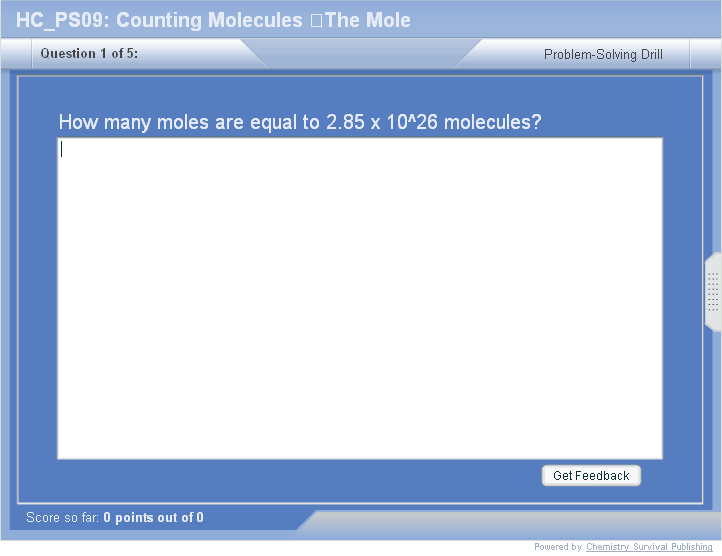
Core Concept Tutorial Problem Solving Drill Review Cheat Sheet

"Title" Tutorial Summary :

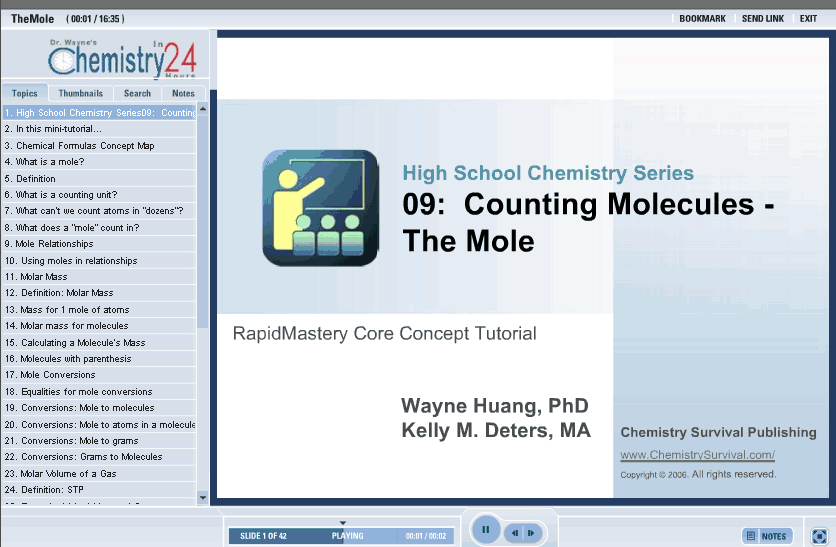
Atoms and molecules are too small to be counted individually, so a counting unit of “mole” is used.  Molar masses are used to convert between mass and moles of atoms or molecules. 

There are several ways to express the ratio of moles of atoms in a sample.  The tutorial introduces percent composition, empirical formula and molecular formula.


Tutorial Features:

Series Features:

  • Concept map showing inter-connections of new concepts in this tutorial and those previously introduced.
  • Definition slides introduce terms as they are needed.
  • Visual representation of concepts
  • Animated examples—worked out step by step
  • A concise summary is given at the conclusion of the tutorial.

"Title" Topic List:
  • The Mole
    • Mole relationships
  • Molar Mass
    • Calculating
    • Using in mole conversions
  • Percent Composition
  • Empirical formulas
  • Molecular formulas


See all 24 lessons in college chemistry, including concept tutorials, problem drills and cheat sheets:
Teach Yourself HighSchool Chemistry Visually in 24 Hours

© 2010 Rapid Learning Inc. All rights reserved         Disclaimer | Privacy Policy | Affiliates
BBBOnline Seal Company Rating
Credit Card Merchant Services

SSL Certificates