(877) Rapid-10
Rapid Learning in 24 Hours
  Home Site Map Contact Us
Rapid Learning Member Login  
BBBOnline Seal
 How to Learn in 24 Hours?

 Need Help?
M-F: 9am-5pm(PST):
Toll-Free: (877) RAPID-10
US Direct: (714) 692-2900
Int'l: 001-714-692-2900


24/7 Technical Support:
The Rapid Support Center

Online Order with Instant Access:
Buy Now with Instant Access
 Got Questions?
Frequently Asked Questions
 Need Proof?
Reviews and Testimonials


 Quick Search:
Keywords: 
 

 Member Login:
User ID: 
Password: 
 

 Rapid Learning Catalog:

AP in 24 Hours

MCAT in 24 Hours (Medical)

DAT in 24 Hours (Dental)

OAT in 24 Hours (Optometry)

PCAT in 24 Hours (Pharmacy)

Nursing Entrance Exams

Chemistry in 24 Hours

Biology in 24 Hours

Physics in 24 Hours

Mathematics in 24 Hours

eBook - Survival Kits

Audiobooks (MP3)


 Tell-A-Friend:
Have friends taking science and math courses too? Tell them about our rapid learning system.

 Gift Certificate:

Send a gift of education to someone you care. Give the learning edge with our rapid learning courses.

Product Code
  • RL-700-GP Premium
  • RL-700-GS Standard
  • RL-700-GL Lite

FAIL (the browser should render some flash content, not this).

Alcohols and Ethers

Topic Review on "Title":

Background for Alcohols and Ethers
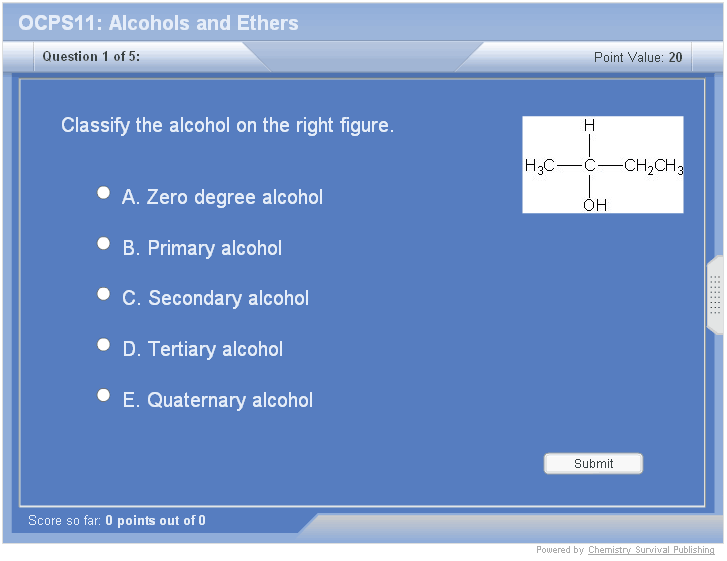
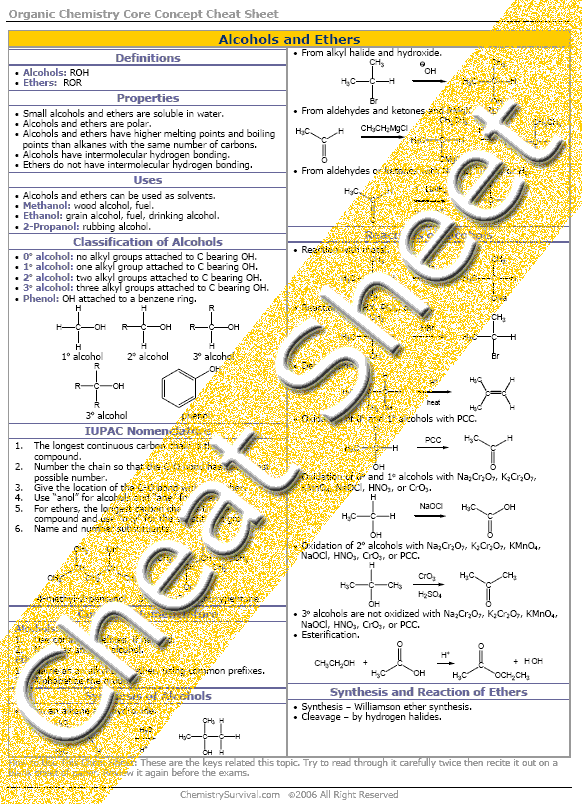
Alcohols contain an alkyl group attached to an OH.  Ethers contain two alkyl groups attached to an oxygen.  Small alcohols and ethers are soluble in water.  Alcohols and ethers are polar.  Alcohols and ethers have higher melting points and boiling points than alkanes with the same number of carbons.  Alcohols have intermolecular hydrogen bonding.  Ethers do not have intermolecular hydrogen bonding.  A 0o alcohol has no alkyl groups attached to C bearing OH.  A 1o alcohol has one alkyl group attached to C bearing OH.  A 2o alcohol has two alkyl groups attached to C bearing OH. A 3o alcohol has three alkyl groups attached to C bearing OH.  A phenol has OH attached to a benzene ring.

IUPAC Nomenclature for Alcohols and Ethers
The longest continuous carbon chain is the parent compound.  Number the chain so that the C-O bond has the lowest possible number.  Give the location of the C-O bond with a number.  Use Aanol@ for alcohols and Aane@ for ethers.  For ethers, the longest carbon chain is the parent compound and use Aoxy@ for the substituent group.  Name and number substituents.

Common Nomenclature for Alcohols and Ethers
For alcohols, use common prefixes, if needed.  An alcohol is named as an alkyl alcohol.  An ether is named as an alkyl alkyl ether, using common prefixes.  Alphabetize the groups.

Synthesis of Alcohols
Alkenes react with water, in the presence of acid, to yield alcohols.  The mechanism follows Markovnikov addition. Alkyl halides react with hydroxide to produce alcohols. Organolithium or Grignard reagents add to aldehydes and ketones to produce alcohols.  Hydrogen, from sodium borohydride, lithium aluminum hydride, or hydrogen, adds to aldehydes and ketones to produce alcohols.

Reactions of Alcohols
Alkoxide ions are formed from the reaction of alcohols with metal.  Alcohols react with hydrogen halide, phosphorus trihalide, or thionyl chloride to form alkyl halides. Alcohols are dehydrated with acid and heat to form alkenes.  Zero degree and primary alcohols are oxidized with pyridinium chlorochromate to form aldehydes.  Zero degree and primary alcohols are oxidized with sodium dichromate, potassium dichromate, potassium permanganate, sodium hypochlorite, nitric acid, or chromium trioxide to form carboxylic acids.  Secondary alcohols are oxidized with sodium dichromate, potassium dichromate, potassium permanganate, sodium hypochlorite, nitric acid, chromium trioxide, or pyridinium chlorochromate to ketones.  Tertiary alcohols are not oxidized with sodium dichromate, potassium dichromate, potassium permanganate, sodium hypochlorite, nitric acid, chromium trioxide, or pyridinium chlorochromate. Alcohols react with carboxylic acids, in the presence of acid, to yield esters.

Synthesis and Reactions of Ethers
In the Williamson ether synthesis, alkoxide ions react with zero degree or primary alkyl halides to form ethers. Ethers are cleaved with hydrogen halides to form alkyl halides and alcohols.  The alkyl group in the alkyl halide is the least hindered alkyl group in the ether.


Rapid Study Kit for "Title":
Flash Movie Flash Game Flash Card
Core Concept Tutorial Problem Solving Drill Review Cheat Sheet

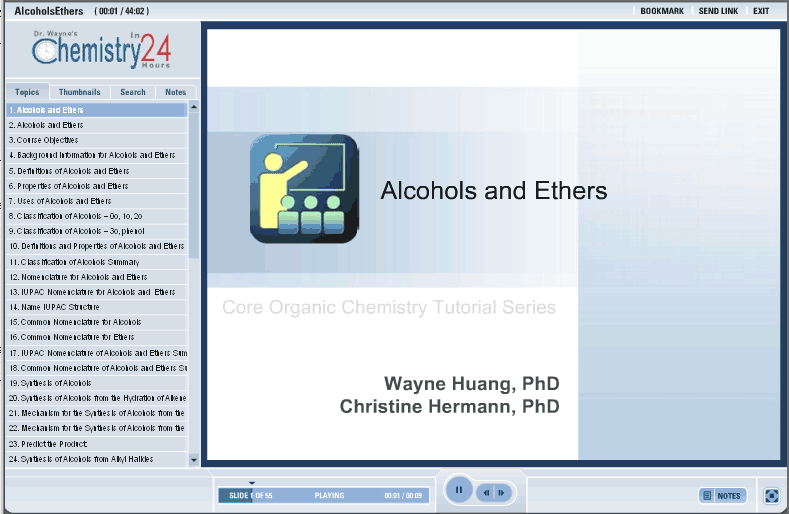
"Title" Tutorial Summary :
The background information of alcohols and ethers will be described in terms of definitions, properties, uses, and classification.  Alcohols are classified by the number of carbons attached to the carbon bearing the oxygen.  The IUPAC and common rules for naming alcohols and ethers will be given.  Alkenes are hydrated to given alcohols.  Alkyl halides react with base to produce alcohols.  Organometallic reagents react with aldehydes and ketones to give alcohols.  Reduction of aldehydes and ketones give alcohols.  Alcohols can form alkoxide ions by the treatment of the alcohol with metal or base.  Alcohols can be converted to alkyl halides.  Dehydration of alcohols yield alkenes.  Primary alcohols are oxidized to aldehydes and carboxylic acids.  Second alcohols are oxidized to ketones.  Tertiary alcohols are not oxidized.  Carboxylic acids react with alcohols to give esters.  Ethers are synthesized by the Williamson ether synthesis.  Ethers undergo cleavage in the presence of acid.

Tutorial Features:

This tutorial provides the comprehensive coverage of the chapter with easy introduction and simple illustration. It features:

  • Concept map showing interconnections of new concepts in this tutorial and those previously introduced.
  • Definition slides introduce terms as they are needed.
  • Visual representation of concepts.
  • Use of colors to emphasis points.
  • Outline of chemical properties, uses, and classification.
  • Easy-to-follow animations of stated rules of nomenclature.
  • Detailed stepwise explanations and animations of reactions and mechanisms.
  • Examples worked out step-by-step throughout the tutorial.
  • A concise summary is given at the conclusion of the tutorial.

"Title" Topic List:

Background Information for Alcohols and Ethers

  • Definitions
  • Properties
  • Uses
  • Classification 

Nomenclature of Alcohols and Ethers

  • IUPAC
  • Common

Synthesis of Alcohols

  • From Alkenes
  • From Alkyl Halides
  • From Organometallic Reagents with Aldehydes and Ketones
  • From Reduction of Aldehydes and Ketones

Reactions of Alcohols

  • Formation of Alkoxide Ions
  • Formation of Alkyl Halides
  • Dehydration
  • Oxidation
  • Esterification

Synthesis and Reactions of Ethers

  • Williamson Ether Synthesis
  • Cleavage of Ethers


See all 24 lessons in college chemistry, including concept tutorials, problem drills and cheat sheets:
Teach Yourself Organic Chemistry Visually in 24 Hours

© 2010 Rapid Learning Inc. All rights reserved         Disclaimer | Privacy Policy | Affiliates
BBBOnline Seal Company Rating
Credit Card Merchant Services

SSL Certificates