(877) Rapid-10
Rapid Learning in 24 Hours
  Home Site Map Contact Us
Rapid Learning Member Login  
BBBOnline Seal
 How to Learn in 24 Hours?

 Need Help?
M-F: 9am-5pm(PST):
Toll-Free: (877) RAPID-10
US Direct: (714) 692-2900
Int'l: 001-714-692-2900


24/7 Technical Support:
The Rapid Support Center

Online Order with Instant Access:
Buy Now with Instant Access
 Got Questions?
Frequently Asked Questions
 Need Proof?
Reviews and Testimonials


 Quick Search:
Keywords: 
 

 Member Login:
User ID: 
Password: 
 

 Rapid Learning Catalog:

AP in 24 Hours

MCAT in 24 Hours (Medical)

DAT in 24 Hours (Dental)

OAT in 24 Hours (Optometry)

PCAT in 24 Hours (Pharmacy)

Nursing Entrance Exams

Chemistry in 24 Hours

Biology in 24 Hours

Physics in 24 Hours

Mathematics in 24 Hours

eBook - Survival Kits

Audiobooks (MP3)


 Tell-A-Friend:
Have friends taking science and math courses too? Tell them about our rapid learning system.

 Gift Certificate:

Send a gift of education to someone you care. Give the learning edge with our rapid learning courses.

Product Code
  • RL-700-GP Premium
  • RL-700-GS Standard
  • RL-700-GL Lite

FAIL (the browser should render some flash content, not this).

Gas Laws

Topic Review on "Title":

Gases are the state of matter with the greatest amount of energy. 

Pressure
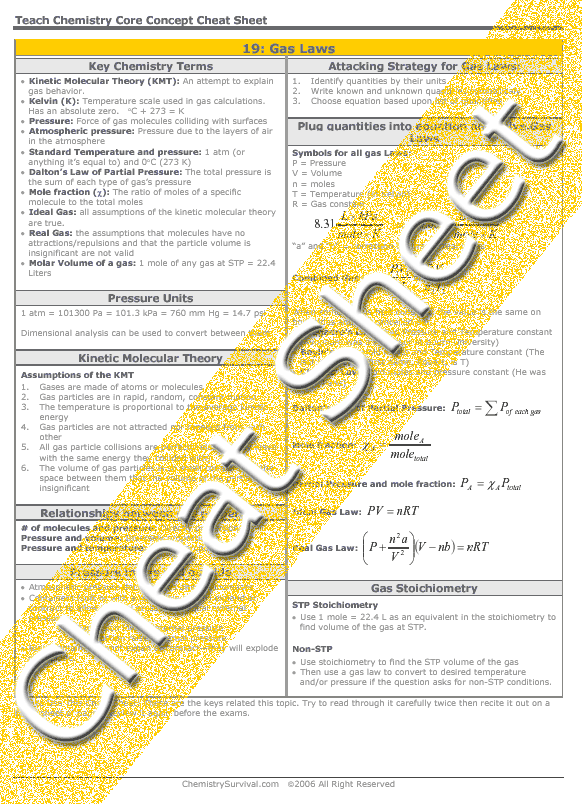
Pressure is created by gas particles running into the wall of the container.  Pressure is measured in many units: 1 atm = 101300 Pa = 101.3 kPa = 760 mm Hg = 14.7 psi.  Atmospheric pressure is the pressure due to the layers of atmosphere above us. 

Kinetic Molecular Theory
The Kinetic Molecular Theory has several assumptions for ideal gases. 

  • Gases are made of atoms or molecules
  • Gas particles are in rapid, random, constant motion
  • The temperature is proportional to the average kinetic energy
  • Gas particles are not attracted nor repelled from each other
  • All gas particle collisions are perfectly elastic (they leave with the same energy they collided with)
  • The volume of gas particles is so small compared to the space between them that the volume of the particle is insignificant

Real gases do have a volume (that takes up space which other particles cannot occupy) and they do have attractions/repulsions from one another as well as in-elastic collisions. 

The KMT is used to understand gas behavior.  Pressure and volume are inversely proportional.  Pressure and temperature are directly proportional.  Pressure and number of particles are directly proportional.

An expandable container will expand or contract so that the internal and external pressures are the same.  Non-expandable containers will explode or implode if the difference in the pressures is too great for the container to withstand.

Gas Laws
Symbols for all gas Laws:
P = Pressure; V = Volume; n = moles; T = Temperature (in Kelvin);
R = Gas constant           or   
“a” and “b” = correction factors for real gases

Combined Gas Law:     When something is held constant, it cancels out.
Dalton’s Law of Partial Pressure:         

Mole fraction:            Partial Pressure and mole fraction:
Ideal Gas Law:             Ideal Gas Law with Molar Mass:
Ideal Gas Law with Density:
Real Gas Law:

Gas Stoichiometry
Use the molar volume of a gas at STP (1 mole of any gas at STP = 22.4 L) to convert between moles and liters of a gas in stoichiometry.  Then use the appropriate gas law to find the volume at non-STP conditions.


Rapid Study Kit for "Title":
Flash Movie Flash Game Flash Card
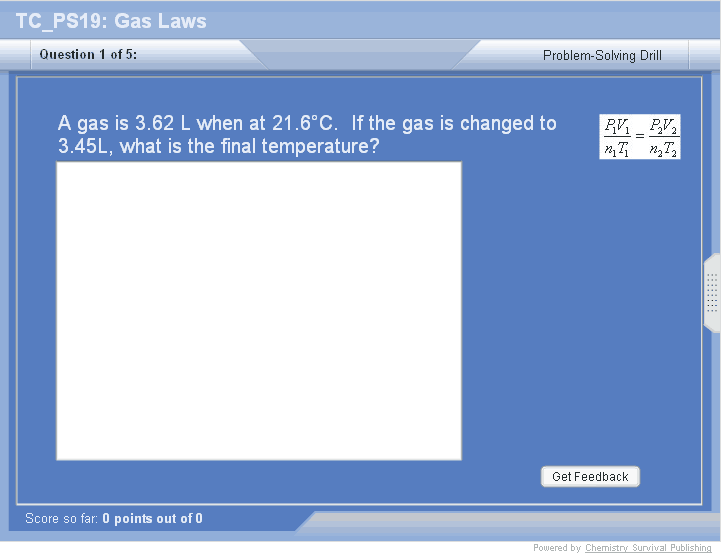
Core Concept Tutorial Problem Solving Drill Review Cheat Sheet

"Title" Tutorial Summary :

The most energetic of the three states of matter, gases, has several laws that describe behavior.  The Kinetic Molecular Theory attempts to explain gas behavior.  This tutorial will introduce the KTM, pressure, gas behavior and several gas laws.


Tutorial Features:

Specific Tutorial Features:

  • Animated visualization of gas particles and gas behavior
  • Conceptual explanations of gas behavior along with mathematical gas laws
  • Problem solving strategy for solving gas law problems
  • Combination several gas laws into 1 for less confusion in choosing the appropriate law

Series Features:

  • Concept map showing inter-connections of new concepts in this tutorial and those previously introduced.
  • Definition slides introduce terms as they are needed.
  • Visual representation of concepts
  • Animated examples—worked out step by step
  • A concise summary is given at the conclusion of the tutorial.

"Title" Topic List:
  • Pressure
    • What is pressure?
    • Atmospheric pressure
    • Units of pressure
  • Kinetic Molecular Theory
    • Ideal versus real gases
  • Explanations of gas behavior
    • Relationships between pressure, volume and temperature
    • Internal versus external pressure
  • Gas laws
    • Avogadro’s
    • Boyles’
    • Charles’
    • Combined
    • Partial Pressure
      • Mole fractions
    • Ideal
      • With density
      • With molar mass
    • Real
  • Gas stoichiometry


See all 24 lessons in college chemistry, including concept tutorials, problem drills and cheat sheets:
Learn Yourself to Teach Chemistry Visually in 24 Hours

© 2010 Rapid Learning Inc. All rights reserved         Disclaimer | Privacy Policy | Affiliates
BBBOnline Seal Company Rating
Credit Card Merchant Services

SSL Certificates