(877) Rapid-10
Rapid Learning in 24 Hours
  Home Site Map Contact Us
Rapid Learning Member Login  
BBBOnline Seal
 How to Learn in 24 Hours?

 Need Help?
M-F: 9am-5pm(PST):
Toll-Free: (877) RAPID-10
US Direct: (714) 692-2900
Int'l: 001-714-692-2900


24/7 Technical Support:
The Rapid Support Center

Online Order with Instant Access:
Buy Now with Instant Access
 Got Questions?
Frequently Asked Questions
 Need Proof?
Reviews and Testimonials


 Quick Search:
Keywords: 
 

 Member Login:
User ID: 
Password: 
 

 Rapid Learning Catalog:

AP in 24 Hours

MCAT in 24 Hours (Medical)

DAT in 24 Hours (Dental)

OAT in 24 Hours (Optometry)

PCAT in 24 Hours (Pharmacy)

Nursing Entrance Exams

Chemistry in 24 Hours

Biology in 24 Hours

Physics in 24 Hours

Mathematics in 24 Hours

eBook - Survival Kits

Audiobooks (MP3)


 Tell-A-Friend:
Have friends taking science and math courses too? Tell them about our rapid learning system.

 Gift Certificate:

Send a gift of education to someone you care. Give the learning edge with our rapid learning courses.

Product Code
  • RL-700-GP Premium
  • RL-700-GS Standard
  • RL-700-GL Lite

FAIL (the browser should render some flash content, not this).

Naming Chemical Compounds

Topic Review on "Title":

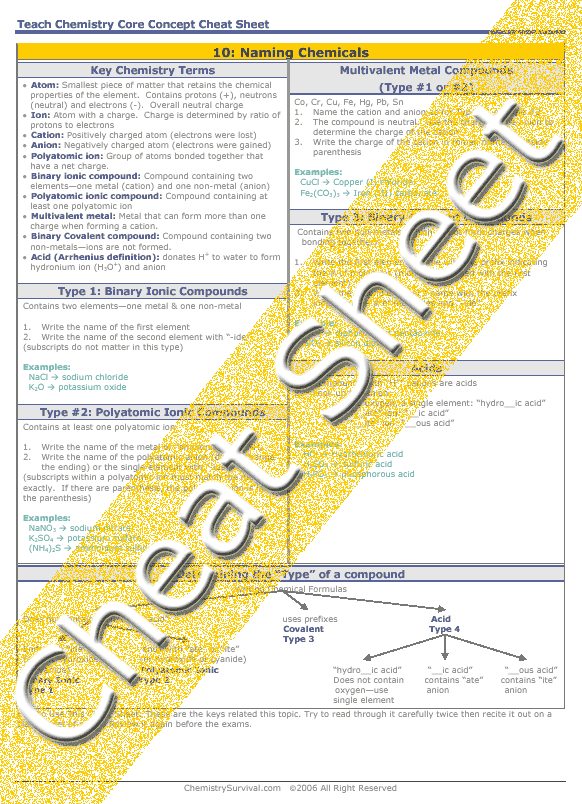
Chemical formulas are named with rules according to the type of molecule.

Type 1: Binary Ionic
Between a metal and a non-metal—one element of each type.  Write the name of the first element (the metal) and then the name of the second element with “-ide” replacing the last syllable.  Subscripts are not important when using this type

Type 2: Polyatomic Ionic
It will contain more than 2 elements—with at least one being a metal and one being a non-metal.  Write the name of the first element or polyatomic ion.  Write the name of the second element or polyatomic ion.  If the anion is an element, change the ending to “-ide”; if the anion is a polyatomic ion, do not change the ending.  Polyatomic ions must match exactly—including the subscripts.  If there are parenthesis, the polyatomic ion is inside the parenthesis.

Type 1 or 2 with Multivalent Metals
They’ll start with Co, Cr, Cu, Fe, Hg, Pb, Sn.  Multivalent metals are metals that have more than one possibility for the charge.  The name of the metal is written, followed by roman numerals in parenthesis indicating the charge of the metal.  The charge is determined by knowing the charge of the anion and knowing that the overall charge of the molecule is 0.  The name of the anion is written—changing the ending of a single element anion to “-ide.”

Type 3: Binary Covalent
Between two non-metals.  Write the name of the first element with a prefix indicating the subscript (do not use “mono-“ with the first element).  Write the name of the second element with a prefix indicating the subscript and “-ide” as the ending syllable.

Type 4: Acids
The cation for an acid is H+.  The name is based on the anion.  A single element anion is named as “hydro____ic acid”; a “___ate” polyatomic anion is named as “___ic acid”; a “___ite” polyatomic anion is named as “___ous” acid.



Rapid Study Kit for "Title":
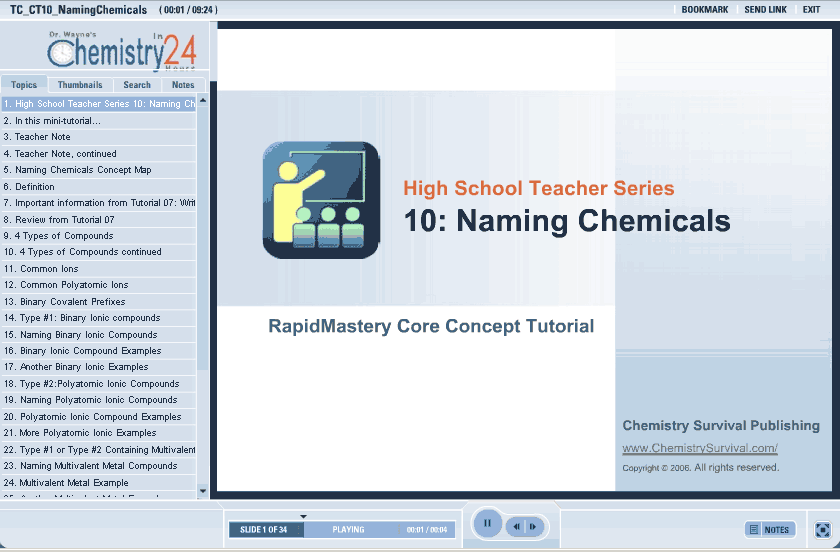
Flash Movie Flash Game Flash Card
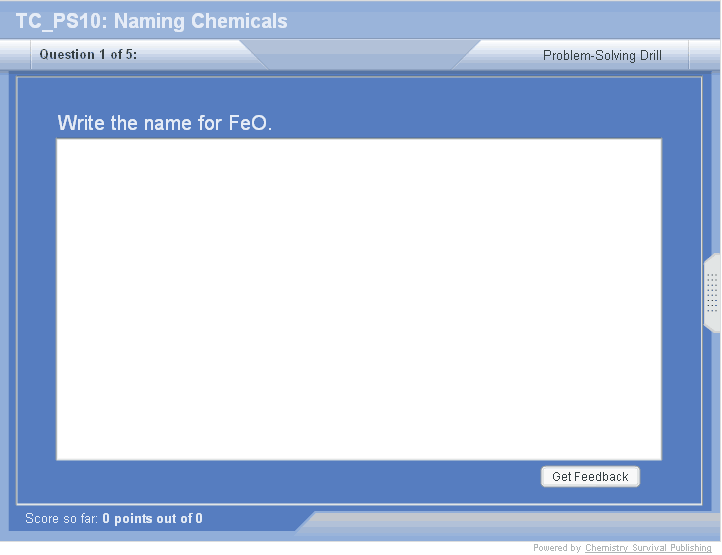
Core Concept Tutorial Problem Solving Drill Review Cheat Sheet

"Title" Tutorial Summary :

It is critical to be able to write and read chemical formulas to function in a chemistry course.  This tutorial introduces 4 different types of chemical formulas and gives instruction on how to recognize and name each type.


Tutorial Features:

Specific Tutorial Features:

  • Nomenclature is broken down into separate types
  • Organizational chart at end to guide type selection

Series Features:

  • Concept map showing inter-connections of new concepts in this tutorial and those previously introduced.
  • Definition slides introduce terms as they are needed.
  • Visual representation of concepts
  • Animated examples—worked out step by step
  • A concise summary is given at the conclusion of the tutorial.

"Title" Topic List:
  • Naming chemical formulas
    • Binary Ionic
    • Polyatomic Ionic
    • Ionic with multivalent metals
    • Binary Covalent
    • Acids


See all 24 lessons in college chemistry, including concept tutorials, problem drills and cheat sheets:
Learn Yourself to Teach Chemistry Visually in 24 Hours

© 2010 Rapid Learning Inc. All rights reserved         Disclaimer | Privacy Policy | Affiliates
BBBOnline Seal Company Rating
Credit Card Merchant Services

SSL Certificates