(877) Rapid-10
Rapid Learning in 24 Hours
  Home Site Map Contact Us
Rapid Learning Member Login  
BBBOnline Seal
 How to Learn in 24 Hours?

 Need Help?
M-F: 9am-5pm(PST):
Toll-Free: (877) RAPID-10
US Direct: (714) 692-2900
Int'l: 001-714-692-2900


24/7 Technical Support:
The Rapid Support Center

Online Order with Instant Access:
Buy Now with Instant Access
 Got Questions?
Frequently Asked Questions
 Need Proof?
Reviews and Testimonials


 Quick Search:
Keywords: 
 

 Member Login:
User ID: 
Password: 
 

 Rapid Learning Catalog:

AP in 24 Hours

MCAT in 24 Hours (Medical)

DAT in 24 Hours (Dental)

OAT in 24 Hours (Optometry)

PCAT in 24 Hours (Pharmacy)

Nursing Entrance Exams

Chemistry in 24 Hours

Biology in 24 Hours

Physics in 24 Hours

Mathematics in 24 Hours

eBook - Survival Kits

Audiobooks (MP3)


 Tell-A-Friend:
Have friends taking science and math courses too? Tell them about our rapid learning system.

 Gift Certificate:

Send a gift of education to someone you care. Give the learning edge with our rapid learning courses.

Product Code
  • RL-700-GP Premium
  • RL-700-GS Standard
  • RL-700-GL Lite

FAIL (the browser should render some flash content, not this).

Graphs of Trigonometric Functions

Topic Review on "Title":

Periodic function:

A periodic function must have the characteristic of where is the period.

 Horizontal shift of a function:

The graph of is the graph of shifted horizontally by a units.

 Vertical stretching of a function:

The graph of is the graph of stretched vertically by a units.

 Horizontal shrinking of a function:

The graph of is the graph of shrunk horizontally by a units..

 Reflection and vertical shift of a function:

The graph of is the reflection of the graph about x-axis.

The graph of is the graph of shifted vertically by a units.

Sinusoidal functions:

Functions whose equations satisfy .

 Amplitude:

Amplitude is a nonnegative scalar measure of the magnitude of sinusoidal functions.

 Period: For a sinusoidal function  the absolute value of is the period of the  sinusoidal function.

Phase shift of a sinusoidal function:

For a sinusoidal function  the value of  is the phase shift of the sinusoidal function.



Rapid Study Kit for "Title":
Flash Movie Flash Game Flash Card
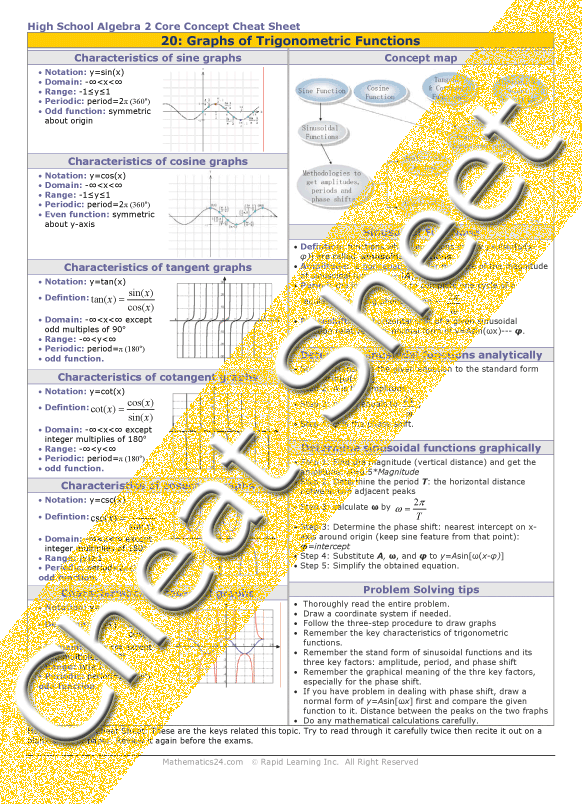
Core Concept Tutorial Problem Solving Drill Review Cheat Sheet

"Title" Tutorial Summary :

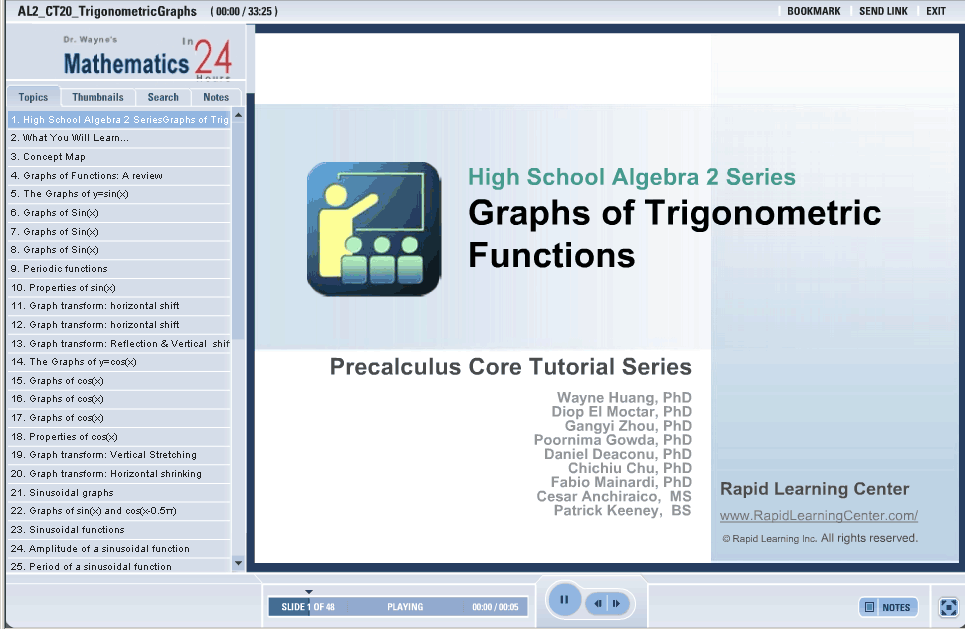
This tutorial is all about the graphs of the trigonometric functions.  First, the graphs of sine, cosine, tangent, cotangent, cosecant and secant functions are introduced with the help of examples. Next, equations for a sinusoidal graph are shown in examples with the sine and cosine functions. Properties of sinusoidal functions such as amplitude and period are introduced with graphs and tables.

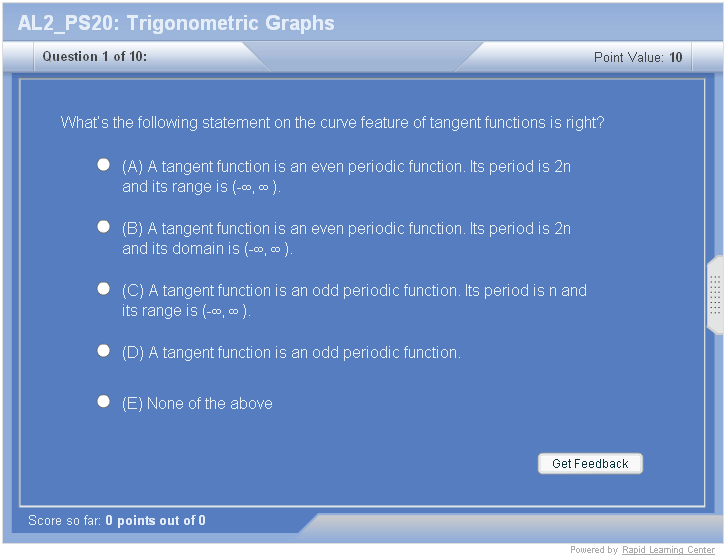
Next, the transformations of sinusoidal graphs are shown in the examples. The phase shift of a sinusoidal function is defined with a graphical illustration. There are two methodologies to obtain amplitude, period and phase shifts of trigonometric functions. Last, the tangent and the remaining trigonometric equations are defined in terms of their periodicity and amplitude.


Tutorial Features:

Specific Tutorial Features:
• Animated graphs showing the different types of trigonometric functions
• Graphic organizers to illustrate concept relationships.

Series Features:
• Concept map showing inter-connections of new concepts in this tutorial and those previously introduced.
• Definition slides introduce terms as they are needed.
• Visual representation of concepts
• Animated examples—worked out step by step
• A concise summary is given at the conclusion of the tutorial.


"Title" Topic List:
The graphs of y= sin(x) Periodic functions Properties of y= sin(x) Graph transformations The graphs of y= cos(x) Properties of y= cos(x) Sinusoidal graphs Graphs of sin(x) and cos(x-0.5pi) Sinusoidal functions Amplitude of a sinusoidal function Period of a sinusoidal function Phase shift of a sinusoidal function The graphs of y=tan(x) Properties of y=tan(x) Graph transformations of y=tan(x) The graphs of y=cot(x) The graphs of y=csc(x) The graphs of y=sec(x)


See all 24 lessons in High School Algebra 2, including concept tutorials, problem drills and cheat sheets:
Teach Yourself High School Algebra 2 Visually in 24 Hours

© 2010 Rapid Learning Inc. All rights reserved         Disclaimer | Privacy Policy | Affiliates
BBBOnline Seal Company Rating
Credit Card Merchant Services

SSL Certificates