(877) Rapid-10
Rapid Learning in 24 Hours
  Home Site Map Contact Us
Rapid Learning Member Login  
BBBOnline Seal
 How to Learn in 24 Hours?

 Need Help?
M-F: 9am-5pm(PST):
Toll-Free: (877) RAPID-10
US Direct: (714) 692-2900
Int'l: 001-714-692-2900


24/7 Technical Support:
The Rapid Support Center

Online Order with Instant Access:
Buy Now with Instant Access
 Got Questions?
Frequently Asked Questions
 Need Proof?
Reviews and Testimonials


 Quick Search:
Keywords: 
 

 Member Login:
User ID: 
Password: 
 

 Rapid Learning Catalog:

AP in 24 Hours

MCAT in 24 Hours (Medical)

DAT in 24 Hours (Dental)

OAT in 24 Hours (Optometry)

PCAT in 24 Hours (Pharmacy)

Nursing Entrance Exams

Chemistry in 24 Hours

Biology in 24 Hours

Physics in 24 Hours

Mathematics in 24 Hours

eBook - Survival Kits

Audiobooks (MP3)


 Tell-A-Friend:
Have friends taking science and math courses too? Tell them about our rapid learning system.

 Gift Certificate:

Send a gift of education to someone you care. Give the learning edge with our rapid learning courses.

Product Code
  • RL-700-GP Premium
  • RL-700-GS Standard
  • RL-700-GL Lite

FAIL (the browser should render some flash content, not this).

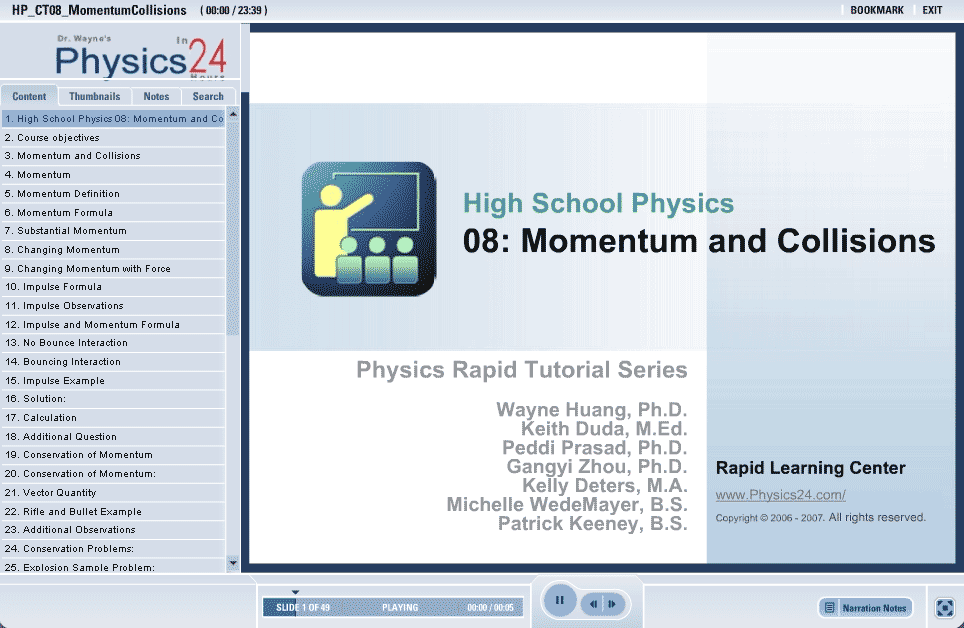
Momentum and Collisions

Topic Review on "Title":

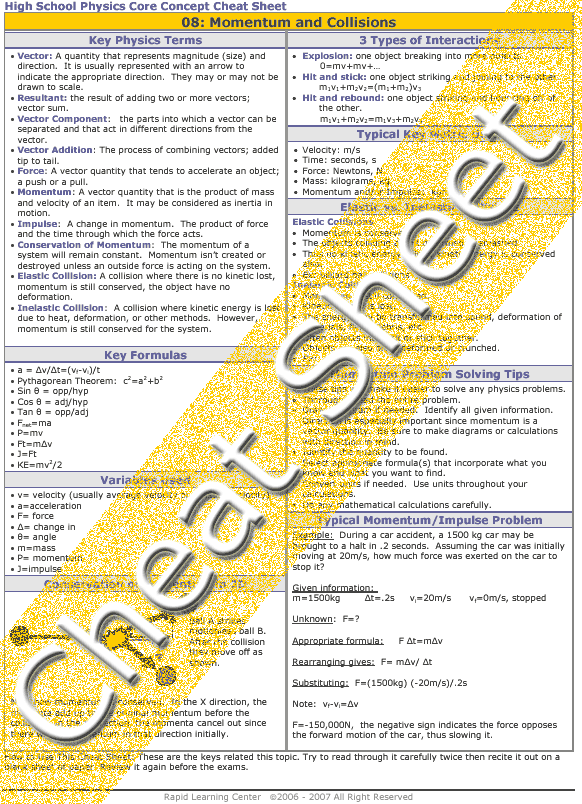
Momentum:  Momemtum may be described as inertia in motion.  It is the product of mass times velocity. P = mv

Impulse: A change in the momentum of an object.  It is the product of force times time. J=Ft The impulse may occur over a long or short time period, and with a large or small force applied to make the change in momentum. 

Conservation of momentum:  Momentum isn’t created or destroyed in a given system.  It may be transferred from one object to another.  Only an outside or external force will change the total momentum.

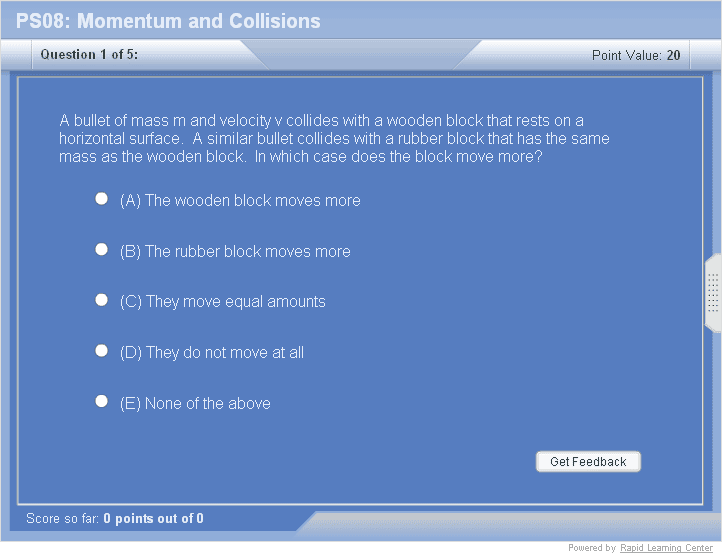
  • When comparing a bouncing collision to a collision where an object is brought to a halt, the bouncing object experiences a much larger impulse.
  • A hit and stick collision is when one object impacts another, then they stay as one.
  • A hit and rebound collision is when one object hits another and they both remain separate.
  • An explosion collision is when an object breaks apart.  It may not necessarily be an explosion.

Elastic collision: An elastic collision is one where:

  • Momentum is conserved. 
  • The objects colliding aren’t deformed or smashed
  • Thus no kinetic energy is lost; kinetic energy is conserved also. 
  • Ex: billiard ball collisions

Inelastic collisions: An inelastic collsion is one where:

  • Momentum is still conserved, but kinetic energy is lost.
  • The lost kinetic energy will be transformed into other types.
  • The objects often interlock and stick together, they may also be deformed and mangled.
  • Ex: car crash

Rapid Study Kit for "Title":
Flash Movie Flash Game Flash Card
Core Concept Tutorial Problem Solving Drill Review Cheat Sheet

"Title" Tutorial Summary :

This tutorial describes the concept of momentum.  This is very similar to inertia in motion.  Once a moving object has momentum, it may be changed and brought to a halt.  This change in momentum is called impulse.  Anytime there is some type of collision or interaction, momentum is transferred.  This tutorial describes three main types of momentum collisions: hit and stick, hit and rebound, and explosion.  In all of these, the conservation of momentum is observed.  Momentum isn’t created or destroyed, its just transferred from one item to the next.


Tutorial Features:

Specific Tutorial Features:
• Problem-solving techniques are used to work out and illustrate the example problems, step by step.
• Animated diagrams to accompany example problems, specifically vector diagrams to show conservation of momentum in 2 dimensions.

Series Features:
• Concept map showing inter-connections of new concepts in this tutorial and those previously introduced.
• Definition slides introduce terms as they are needed.
• Visual representation of concepts
• Animated examples—worked out step by step
• A concise summary is given at the conclusion of the tutorial.


"Title" Topic List:

Momentum

Definition
Formula

Impulse

Formula
Examples
Bouncing versus sticking

Conservation of momentum

Collsions
Inelastic versus elastic collisions
2 dimensional collisions


See all 24 lessons in high school  physics, including concept tutorials, problem drills and cheat sheets:
Teach Yourself High School Physics Visually in 24 Hours

© 2010 Rapid Learning Inc. All rights reserved         Disclaimer | Privacy Policy | Affiliates
BBBOnline Seal Company Rating
Credit Card Merchant Services

SSL Certificates