

The audio spectrum extends from approximately 20Hz to 20,000 Hz.Sounds of frequency between 20Hz and 20,000Hz can be heard by human ear
Infrasonic sounds:
Sounds of frequency less than 20Hz are called “infrasonics”.
Ultrasonic sounds:
Sounds of frequency greater than 20,000Hz are called“ultrasonics”.
Ex: Sound produced by bats.
Nodes:
The points of no displacement when standing waves are formed.
Antinodes:
The points along the medium which vibrate back and forth with maximum displacement.
Sound Intensity:
The loudness of sound is directly proportional to the square of the amplitude or intensity (I). It is convenient to use a logarithmic scale to determine the intensity level b = 10 log (I/I0)
Pitch:
Pitch is the highest or lowest sound an object makes.
Beats:
Beats are the periodic and repeating fluctuations heard in the intensity of a sound. Two sound waves of nearly same frequencies interfere with one another to produce beats
The intensity of the resultant wave at a given point in the medium becomes maximum (waxes) and minimum (wanes) periodically.
Doppler Effect:
The apparent change in the frequency of sound due to relative motion between the sound source and observer is called Doppler Effect.
Echoes:
The sound obtained by reflection at a wall, cliff or a mountain is called an echo.
Diffraction:
When waves encounter an obstacle with an edge, some of the wave energy bends around the edge behind the obstacle. This bending is called diffraction.
Rapid Study Kit for "Title":
Flash Movie
Flash Game
Flash Card
Core Concept Tutorial
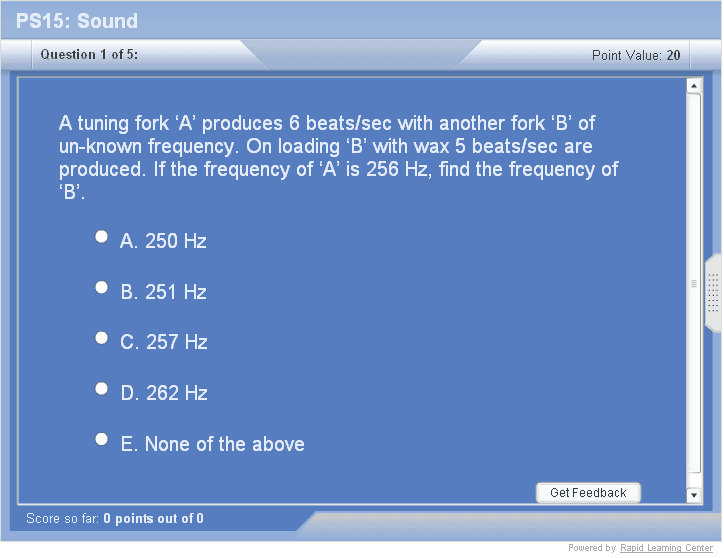
Problem Solving Drill
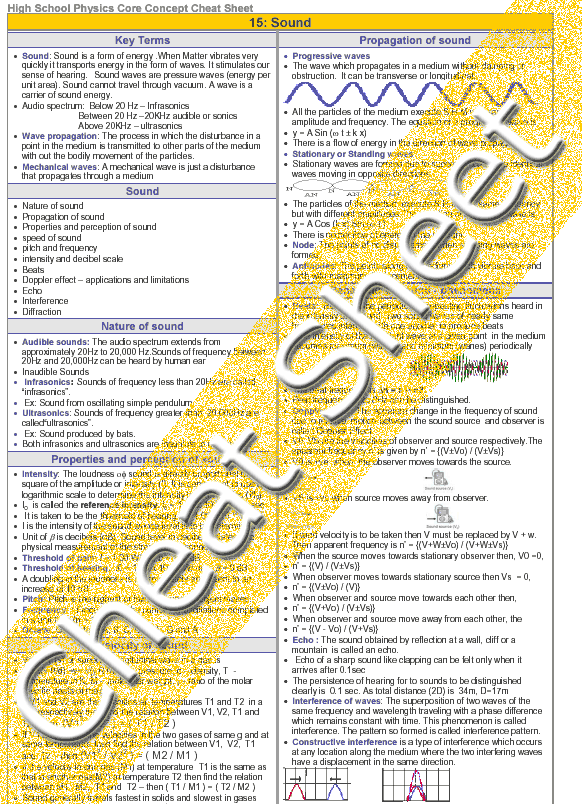
Review Cheat Sheet
"Title" Tutorial Summary :
Sound is one of the most important waves to us. It is both a transverse and longitudinal wave. It exhibits all the regular features of other types of waves. We can describe its frequency and period as it relates to the pitch of a sound heard. We can describe its amplitude as it relates to the intensity or loudness of a sound heard. Sound can travel through a variety of substances, but it must be traveling through something as it is a mechanical wave. There are a variety of mathematical formulas to find the speed of sound through a particular substance. Many times sound waves reflect off hard surfaces. This is called an echo. We can use the Doppler effect for various applications. This relates the change in frequency of a wave to the speed of a moving wave source or wave observer.
Tutorial Features:
Specific Tutorial Features:
• Several example problems with step by step illustrations of solutions.
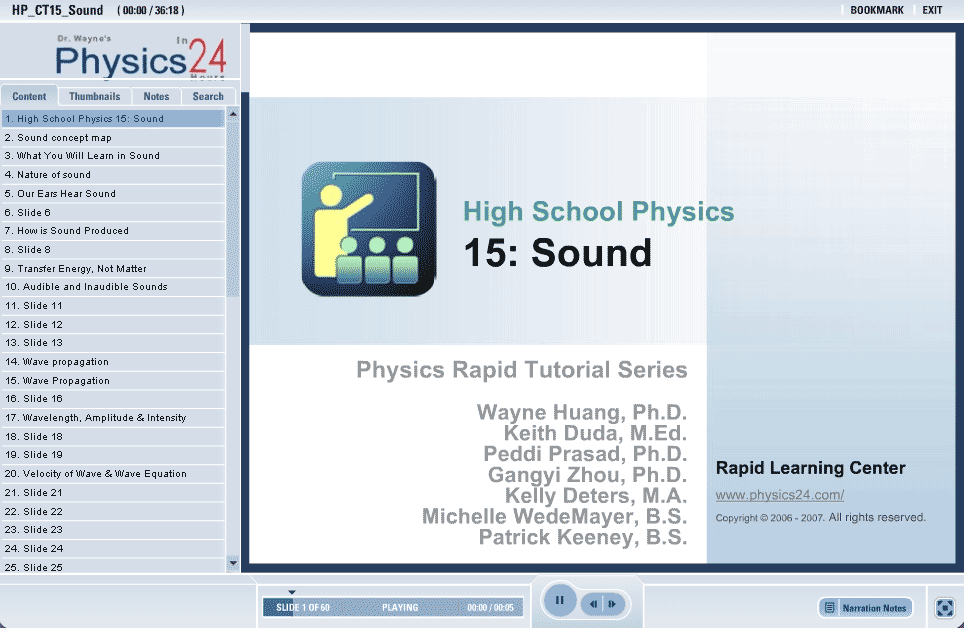
• Animations showing wave motion as it relates to sound.
Series Features:
• Concept map showing inter-connections of new concepts in this tutorial and those previously introduced.
• Definition slides introduce terms as they are needed.
• Visual representation of concepts
• Animated examples—worked out step by step
• A concise summary is given at the conclusion of the tutorial.
"Title" Topic List:
The nature of sound
Our ears
Audible and inaudible sounds
Speed of sound
Types of waves
Speed of various sounds